Right slant
- Visual observation
- Several tall stems lean right relative to the page.
- Traditional interpretation
- Some graphology traditions associate this with sociability.
 Graphology Analyzer
A guide to graphology
Explore traditional graphology claims, understand their scientific limitations, and learn what handwriting analysis can actually observe.
Try AI Handwriting Analyzer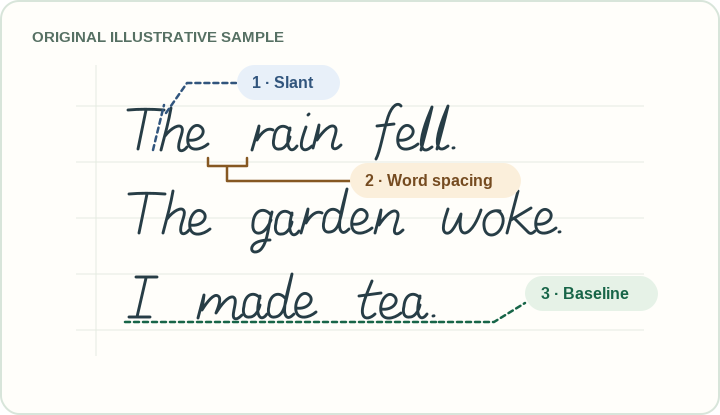
Three concrete comparisons
Where these ideas came from
Modern graphology developed in nineteenth-century France. Writers such as Jean-Hippolyte Michon and Jules Crépieux-Jamin organized handwriting signs into systems of interpretation.
Read the historical studyA reader might compare the lean, spacing, or height of letters and assign symbolic meanings to those patterns. Different traditions can assign different meanings to the same mark.
The same person can write differently when hurried, using a new pen, or writing on a different surface. Those changes make handwriting a poor basis for judging personal traits.
Read more about graphologyWhat can be seen on the page
Image analysis can estimate visible writing features when the photo provides enough evidence. These observations describe the sample and do not determine the writer’s personality.
The direction the main pen strokes lean.
How the heights of comparable letter bodies vary within the sample.
The gaps between words relative to nearby letter spacing.
The vertical separation between successive lines of handwriting.
The direction of the line on which the writing rests.
How steadily the visible features recur across the sample.
Evidence and uncertainty
A personality assessment needs evidence that its results are reliable and relate to the trait being measured. A study comparing graphological ratings with Big Five questionnaire results did not confirm that handwriting analysis could measure those traits.
A handwriting sample cannot establish honesty, intelligence, mental health, or job suitability. A review of graphological predictions in personnel selection noted that even limited predictive value could come from what the writer said, rather than the appearance of the writing.
A photo can obscure strokes, crop off whole lines, or make an even baseline look tilted. AI may mistake paper lines for ink or merge connected letters.
When an observation lacks usable evidence, Unknown is more informative than a confident guess. A clearly annotated finding can still be wrong, so compare it with the visible marks.
Illustrative example
Open an example to compare a visible feature with its traditional interpretation and the limits of that claim.
What you can see Several tall stems lean right relative to the page.
Traditional reading for entertainment Some graphology traditions associate this with sociability.
Pen grip and writing angle can also change the lean. A stem angle cannot tell you how sociable someone is.
What you can see Blank gaps between some words are wider than the gaps between letters.
Traditional reading for entertainment Some readings interpret wider gaps as a sign of independence.
Word length, available space, and writing habits can all affect spacing. The gaps cannot establish independence.
What you can see The resting line of the letters rises and falls across a passage.
Traditional reading for entertainment Some readings associate changes in baseline with emotional variation.
Paper angle, an uneven writing surface, and camera perspective can change the visible line. It cannot establish emotional state.
Upload a handwriting photo to explore six visual writing features with clear explanations.
Handwriting can show patterns such as letter lean or word gaps. Those visible patterns do not reliably establish a writer’s personality.
Research has not established graphology as a reliable personality assessment. A traditional interpretation can be read as entertainment.
This tool estimates slant, relative letter height, word spacing, line spacing, baseline direction, and consistency when the image provides enough evidence.
Handwriting recognition tries to read or transcribe the written words. Graphology assigns traditional meanings to writing patterns. The visual report here describes the shapes and layout.
No. The appearance of handwriting is not a basis for diagnosing a mental health condition.
Answer everyday social questions to see which charisma styles fit your choices.
Continue learning
Explore the history of the practice and its scientific limits.
Read a fictional report alongside its marked evidence.
Compare leaning strokes and account for camera tilt.
Compare the space between words and between writing lines.